British public backs the rainforest: Tony Juniper reflects on YouGov poll
Dr Tony Juniper CBE, previously CEO of Friends of the Earth, is a British ornithologist, environmentalist, author, and Chair of Cool Earth and Natural England. In this piece, Tony Juniper shares his thoughts on the recently commissioned data from YouGov by Cool Earth which shows the extent of British public support for the rainforest and what they’d do to keep it standing.
The British public backs the rainforest
According to a new YouGov poll commissioned by Cool Earth, more than half of Brits agree that the fate of the rainforests has an impact on their daily lives. Even more, nearly two thirds, say they’d be willing to pay more for products if it helped the rainforests. A strong body of positive awareness evidently exists, but for that to make any difference it needs to be harnessed and geared to taking effective action.
This reveals that in a world so rich in data about the scale, character, and implications of the problems caused by deforestation, what to do in rebalancing this epic misallocation of influence and control that lies behind continuing deforestation is a vital question. Many have searched for answers and have been doing so for quite some time.
The history of rainforest protection
The cause of the rainforests has been a prominent environmental theme for decades and for much of my long career I have been connected with it.
In 1990, I joined Friends of the Earth (FoE) to lead their tropical rainforests campaign. One very striking thing I found was how the work we did on that subject was so hugely popular. This was somewhat counter-intuitive, considering how so many of the other questions we sought to address were more local and immediate. Our work to cut traffic pollution, promote recycling, and protect local wildlife habitats had a lot of support, but the big thing that got most people energised was what was happening thousands of miles away in the Amazon, Central Africa, and South-east Asia.
30 years ago, certainly people were inspired by the amazing wildlife of the rainforests, and also sympathetic to the causes of the people who lived there. The struggles of the Penan, Yanomami, Waorani, and many indigenous groups during the 1980s and 1990s sparked movements of international solidarity, as they sought to protect their forest lands from encroachment by loggers, ranchers, oil drilling and minerals companies.
With that public backing in the UK and other countries we managed to get a lot done. We campaigned successfully for changes to overseas development funding, shifted Brazil’s enforcement of illegal logging, and pressed multinationals to take a close look at their supply chains. We successfully challenged proposals for pipelines, roads, dams, and mines, and made the case for more government funding.
During the early 1990s, there was rising awareness about the role of deforestation in climate change. Back then about a fifth of global emissions came from forest destruction. More than three decades later, around a tenth of global emissions comes from deforestation and forest degradation.
We made a lot of progress, but the battle is not over.
The global importance of rainforest ecosystems
It is safe to say that this is not down to an absence of information regarding the importance of such ecosystems. Indeed, since the 1990s our knowledge of their global role has only increased. Back then we knew that the rainforests were vital for protecting natural diversity, we understood the plight of the peoples who lived there and had more and more data about how their destruction would fuel global warming. Since then, it has become apparent how rainforests also underpin global food supply.
In the greatest irony of all we can now say with certainty that forest destruction to make way for crops and livestock undermines, rather than enhances, food security. This is because rainforests are not only so named because of the water that falls upon them, but also for that which they push into the atmosphere. Some of the tens of billions of tonnes of water that each day is pumped into the air from vast expanses of tropical trees travels for thousands of miles from the forests in what have been dubbed ‘sky rivers’.
These are flows of water sent aloft by the forests and which spawn rain clouds far away from the forests. For example, water released into the atmosphere from the Amazon basin rainforests is the source of rain that falls across La Plata Basin of southern South America and the Great Plains of North America. Both these regions are global bread baskets. A lack of water in their grain-producing landscapes will have ramifications for the whole world.
The impact of rainforest loss on the UK
The more we look the more we see how fundamental questions of food security, climate change, and the future of our planet’s web of life are inextricably bound up with the fate of the rainforests. The more they are cleared and degraded, the bigger the costs and risks to our global system. These facts are not only now the domain of environmental groups but are also on the radar of governments concerned about national security. A 2026 British Government report has confirmed the connections between national security and deforestation, including in relation to the risk of the collapse of the Amazon basin rainforests.
With this knowledge it is remarkable how the claim that clearing and plundering the forests for economic growth is a rational choice remains so widely repeated. The logic goes that if extractive and industrial activities are permitted (or promoted) then the overall economic gain will be worth the ecological damage because of the benefits for wealth creation, food supply and economic development.
The main flaw in this argument is that it fails to appreciate the economic and social downsides of such an approach. The extent to which we are embarked on an irrational path driven more by economic vested interests than a rational appreciation of evidence is summed up by the observation of the brilliant American ecologist E.O. Wilson, who in 1990 made the rather astute observation that ‘Destroying rainforest for economic gain is like burning a Renaissance painting to cook a meal.’ Sure, you can heat food, but at catastrophic cost.
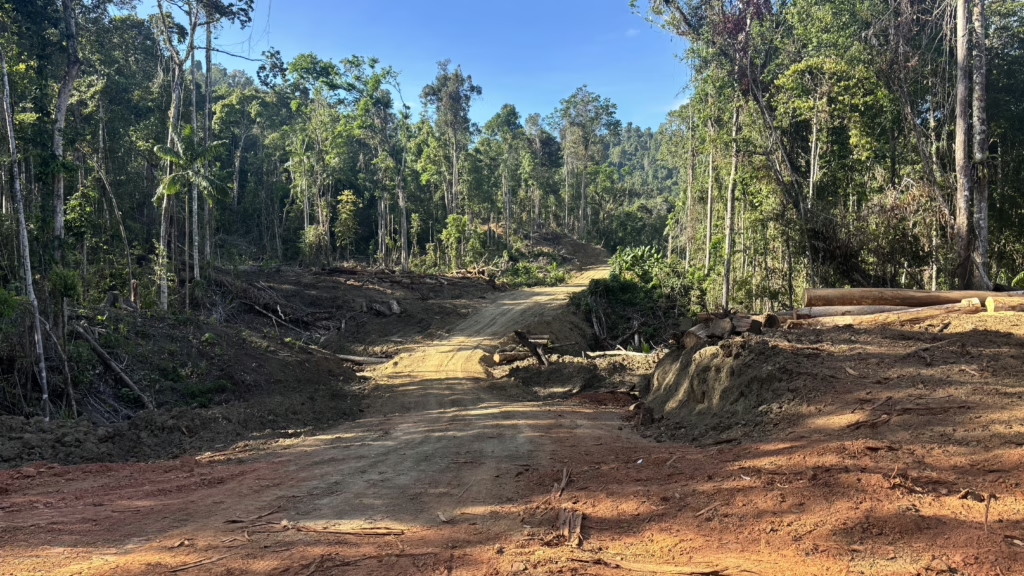
As rainforests continue to be cleared for short term economic gain, an irreplaceable collective asset is stripped to enable the enrichment of logging businesses, cattle companies and palm oil producers, among others. And while they make a lot of money, the costs seen in the effects of global heating, water scarcity and impacts on food supply mean that many others will at the same time face huge costs. On top of that is the loss of irreplaceable natural diversity and massive social dislocation, especially among those who live in the forests that are being liquidated.
The fact that deforestation continues is not because it is a wise or logical choice, but because of how political and economic power is distributed. Those who benefit continue with damaging practices and often are well connected with the political elites who agree with the policies that permit it. This position invites the rather important question: namely, what can be done to change this power imbalance to the point where the destruction is diminished and reversed? As was the case back in my Friends of the Earth days, a big part of the answer is people power.
How people power protects the rainforest
Looking back from 2026 and the experience of previous times, I’d say that the big thing we must crack now is how to redouble people power in challenging the disproportionate power wielded by the interests who continue to destroy the forests. This needs to be via the people living in the forests working in common cause with the millions of concerned citizens who live far away. Both groups suffer the consequences of rainforest loss and have every good reason to work together in forging solutions. This can be done, and the work of Cool Earth reveals how.
By empowering communities living in the forests of the Amazon, African, and the Pacific, Cool Earth is demonstrating a powerful means of taking back power. When communities have enough food, education for their children, and connections to the outside world, they are stronger and less vulnerable to those who would take their trees, rivers, and lands. Cool Earth is good at this and presents data to reveal that when people are supported in ways that make most sense to them then deforestation is drastically reduced.
Deforestation is a complicated subject, but the remedies are sometimes surprisingly straightforward. Including the fact that when people who value forests as their home, as an intact living system, have control of it, then it will be more secure than when those who’d liquidate it for wood, oil, or farmland have control.
An additional and very important simple fact is that we all have the power to help, including through making contributions to the work of Cool Earth. If we give a bit of money, they pass it on to the people at the front line, giving them power and control. It’s a sound investment, it’s easy to do and best of all it works.
Tony Juniper CBE. Chair, Cool Earth.