What is a “Super El Niño” and what does it mean for rainforest?
El Niño is back, and this time the headlines are reaching for the superlatives. “Super El Niño”. “Godzilla El Niño”. They make for memorable headlines, but neither is a scientific category.
This year’s event could be exceptionally strong. But its strength alone cannot tell us which rainforests will become drier, where fires may take hold, or what those changes will mean for the people living in and protecting them.
The more interesting question is what happens when El Niño meets a forest already under pressure.
We’ve developed this article with Professor Mat Collins, climate scientist at the University of Exeter and Field Chief Editor at Frontiers in Climate, to explore what we know about the developing El Niño, what it could mean for tropical rainforests, and where the science leads to more questions.
What is El Niño, and how does it work?
El Niño is the warm phase of the El Niño Southern Oscillation, or ENSO, a natural climate cycle. Peruvian fishermen noticed that unusually warm coastal water tended to arrive around Christmas and named it El Niño, “little boy” in Spanish. El Niño still tends to peak between November and January.
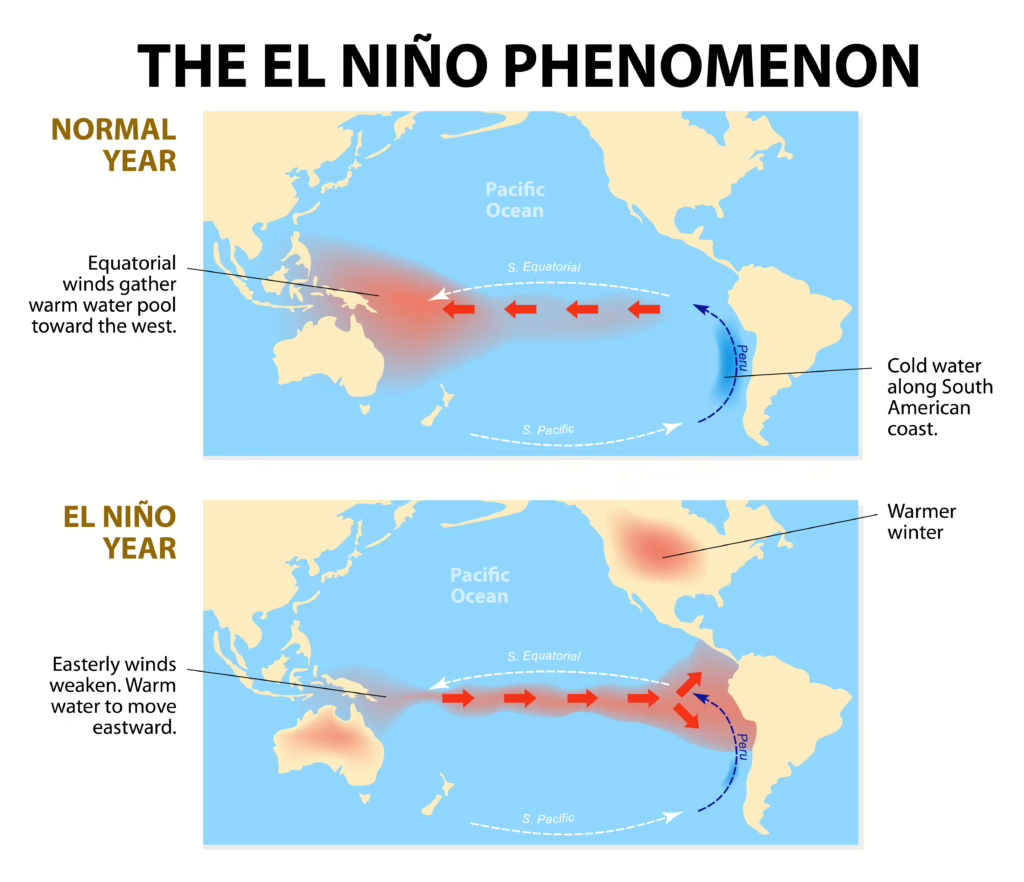
In a typical year, trade winds blow westwards across the Pacific, pushing warm surface water towards Indonesia and New Guinea while cooler water wells up off South America. Warm water fuels rising air, so the western Pacific gets heavy rainfall while the eastern Pacific stays relatively dry.
During El Niño, those trade winds weaken. Warm water spreads eastwards, shifting the zone of rising air and heavy rain with it and rearranging rainfall and drought patterns thousands of miles away. In its sister phase, La Niña, the trade winds strengthen, the eastern Pacific cools and many of El Niño’s effects are reversed.
“Super” and “Godzilla”: what do the forecasts actually tell us?
Due to global warming, El Niño is now measured by how much warmer the central and eastern tropical Pacific is relative to the surrounding tropical Pacific, rather than by its absolute sea-surface temperature alone. An El Niño is declared when that region runs at least 0.5°C warmer than average for a sustained period. Events are then described informally as weak, moderate, strong or very strong, with “very strong” generally reserved for anomalies of 2°C or more.
This year’s event could be the strongest on record. On 21 October 2026, the World Meteorological Organization projected that sea-surface temperatures in parts of the equatorial Pacific could average around 3.8°C above the reference-period average between November 2026 and January 2027.
That figure describes how much warmer one part of the Pacific could be than usual. It does not mean global temperatures will rise by 3.8°C, or guarantee any particular weather on land. A stronger El Niño shifts the odds, but it is only one part of the picture.
What impacts can we expect, and how does climate change affect them?
El Niño typically brings drought to Southeast Asia, Australia, and parts of the Amazon, heavy rain to other parts of South America and the southern United States.
But every El Niño now unfolds on a warmer planet. This event also follows another record-breaking summer, so its effects will land on top of conditions we have already experienced.
Disrupted harvests in major producing countries could also put pressure on supplies of coffee, cocoa and rice, showing how changes in the Pacific can find their way into our supermarket aisles.
Scientists are still researching how climate change will affect El Niño itself. What is clearer is the risk created when higher temperatures meet damaged forests and prolonged dry conditions.
Does a strong El Niño mean more wildfires for rainforest?
Rainforest is one of our planet’s greatest carbon sinks, and prolonged dry conditions can make it more vulnerable to fire.
Across our partnerships in the Peruvian Amazon and Papua New Guinea, communities are already experiencing reduced rainfall and drought.
Fires often start when people burn land for agriculture. In wetter conditions they may stay where they started, but during a prolonged dry spell flames can reach the understory — the vegetation beneath the canopy, and spread quickly. Logging and fragmentation expose forest edges to more sun and wind, while previous fires can leave trees more vulnerable to burning again.
Degraded peatland is especially vulnerable. The devastating fires across Borneo show how fire can smoulder underground in drained soils for weeks, burning through carbon stored there for centuries.
In our own partnerships, these pressures are already unfolding. In Cutivireni, Peru, a wildfire covering around 80 hectares in early October had grown to more than 3,000 hectares by 22 October, larger than 4,000 football pitches, burning mainly through primary forest and approaching the Asháninka Communal Reserve.
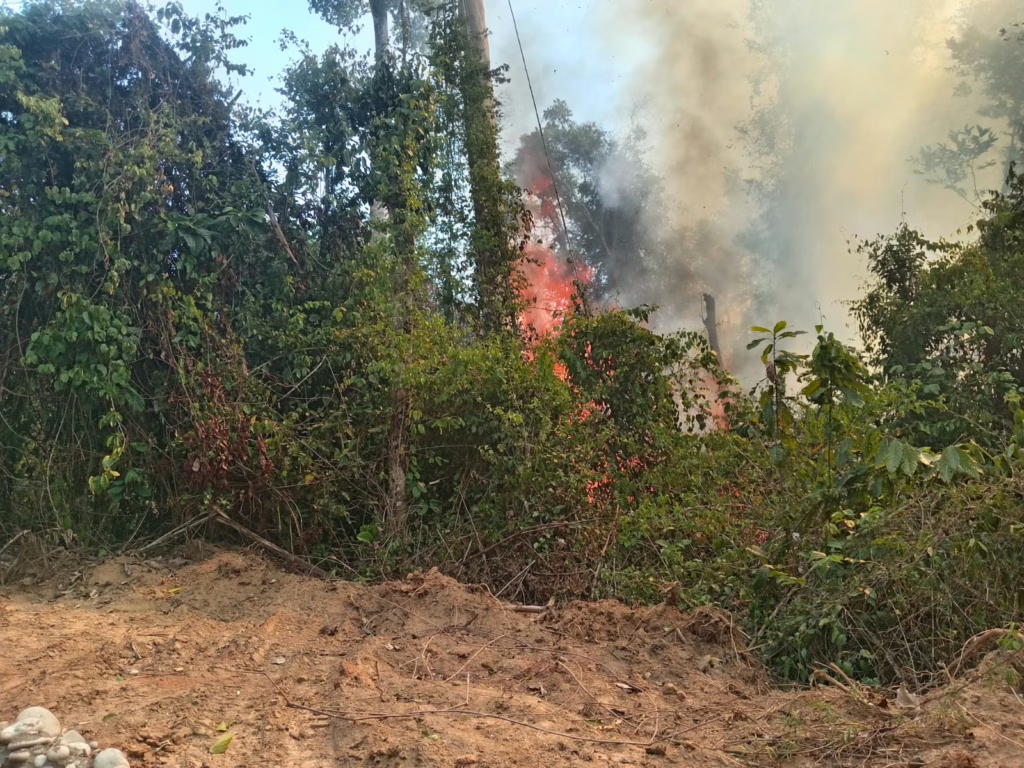
Around 80 families have lost homes, belongings and crops, particularly cacao, an important source of income. Some have been displaced, and children’s schooling has been disrupted.
Fighting fire takes far more than courage. Community brigades need protective equipment, food, tools and enough people to work in rotating teams safely. Without that support, firefighting can be forced to stop while flames continue to spread.
Hotter, drier conditions can help fires spread, but that does not mean El Niño alone caused these fires. In October 2026, NASA also reported increased fire activity across central and eastern parts of the Amazon, as land-management burns escaped into parched forest.
What should we take from all this?
El Niño is a reminder that climate risk is shaped by more than the weather. The condition of a forest before a drought, the pressures placed on it, and the resources available to the people protecting it all influence what happens next.
We cannot control El Niño. But we can reduce the damage extreme conditions can cause by keeping forests standing, protecting intact landscapes, and giving Indigenous communities the resources and autonomy to continue caring for their land.
The most important work happens before a crisis begins. By supporting the people who protect rainforests, we can help build resilience for the difficult seasons ahead, whatever the forecast brings.
Sources:
- WMO: Global Seasonal Climate Update, November 2026–January 2027, 21 October 2026.
- NOAA: ENSO Diagnostic Discussion, 8 October 2026.
- NASA Earth Observatory: Fires Arrive in the Amazon Rainforest, 15 October 2026.
- IPCC: Cross-Chapter Paper 7 — Tropical Forests, Sixth Assessment Report, 2022.
- Sze et al., Current Biology: “Indigenous lands in protected areas have high forest integrity across the tropics”, 2022.