Johan Eliasch: Protecting nature is protecting our future
Johan Eliasch is an entrepreneur, philanthropist, environmental advocate and co-founder of Cool Earth.
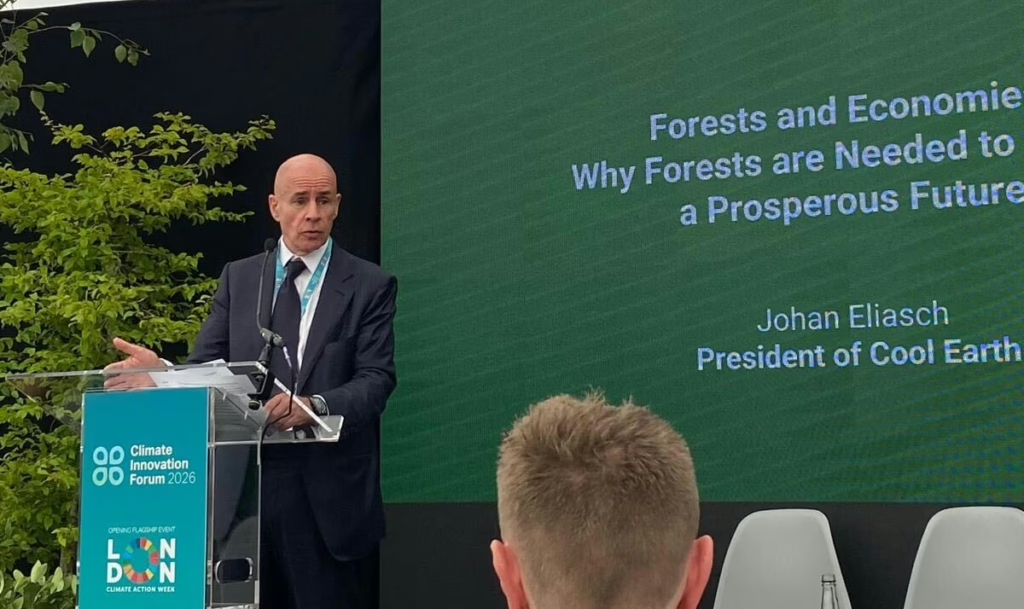
Speaking at the Nature Stage of the Climate Innovation Forum at London Climate Action Week 2026, Johan Eliasch delivered a powerful call to action on one of the defining challenges of our time: protecting the natural systems that underpin global security.
In his speech, Johan Eliasch reflected on how his childhood experiences in Sweden shaped his understanding of nature’s importance, why environmental protection has become one of the defining challenges of our time, and what businesses, governments and individuals must do to safeguard the natural systems that support life on Earth.
Read Johan Eliasch’s speech in full below.
From a stable childhood to an unstable world.
“When I was a child growing up in Sweden, I used to ski to school. That wasn’t remarkable where I lived. It was simply part of life. Winter arrived when it was supposed to. Snow fell when it was meant to. Nature provided a rhythm, a structure, a sense of stability.
Looking back now, I realise how profoundly that shaped me.
The natural world gave me freedom. It gave me resilience. It gave me a lifelong passion for sport, for exploration, for challenge. And, ultimately, it gave me my career.
Because every business success I have had — every company built, every investment made, every opportunity realised — has depended on something we too often take for granted: a healthy natural environment and a stable climate.
Yet, we somehow continue to behave as though protecting the natural systems that sustain us all is optional. A charitable add-on or a side issue. Something to discuss once quarterly targets are met.
The headlines tell a different story and we’ve almost become used to them. The world is becoming hotter, harsher and more unstable. Extreme weather events are part of everyday life. Floods, droughts, fires and heatwaves are destroying homes, businesses and lives across every continent.”
Environmental breakdown is a global risk.
“Biodiversity loss and ecosystem collapse are no longer environmental concerns alone. They are economic risks. They are humanitarian risks. They are national security risks. In the same way that wars are.
For example, The UK Government’s own National Security Risk Assessment, published last year, identified the collapse of ecosystems — including the Amazon rainforest, the Congo Basin, Southeast Asia’s mangroves and the great boreal forests — as a major threat to global stability.
And yet, despite decades of warnings, despite all the conferences, all the declarations and pledges, we are still moving either too slowly or in the wrong direction.”
The reality facing the world’s rainforests.
“Let’s talk about rainforests, as this is an area I know well.
Last month, the Global Forest Review came out and showed that tropical rainforest loss in 2025 fell 36% compared to the record numbers of 2024, the biggest single-year drop in recent memory. We still lost 4.3 million hectares of primary tropical forest, an area the size of Denmark, but it shows that deforestation isn’t inevitable.
Much of it is driven by wildfires intensified by climate change itself, like the El Niño phenomenon, which we are anticipating to be stronger than ever before this year, and could make 2026 numbers disastrous.
Rainforests, the systems that have regulated the Earth’s climate for millions of years, are struggling to survive and if these forests fail, the consequences will be catastrophic.”
Why Cool Earth was founded.
“I co-founded the charity Cool Earth in 2006 because I became convinced that we were overcomplicating solutions to a very urgent problem.
Too often:
- Funding is either inexistent or trapped in bureaucracy.
- The people doing the actual work of protecting nature are the last to benefit.
- Local communities are treated as stakeholders in rainforest protection rather than leaders.
The truth is simple.
The people with the best track record of protecting rainforests are the people who have lived in them for generations. Indigenous peoples and local communities protect nearly half of the world’s remaining rainforests.
They safeguard ecosystems that generate more than a trillion dollars in benefits every year through rainfall regulation, carbon storage, biodiversity and climate stability.
And while the world talks endlessly about carbon markets, offset mechanisms – nature ones being the newest addition with little impact to show for – and future technologies, the people protecting these forests are often left waiting for support that never arrives.”
The power of community-led conservation.
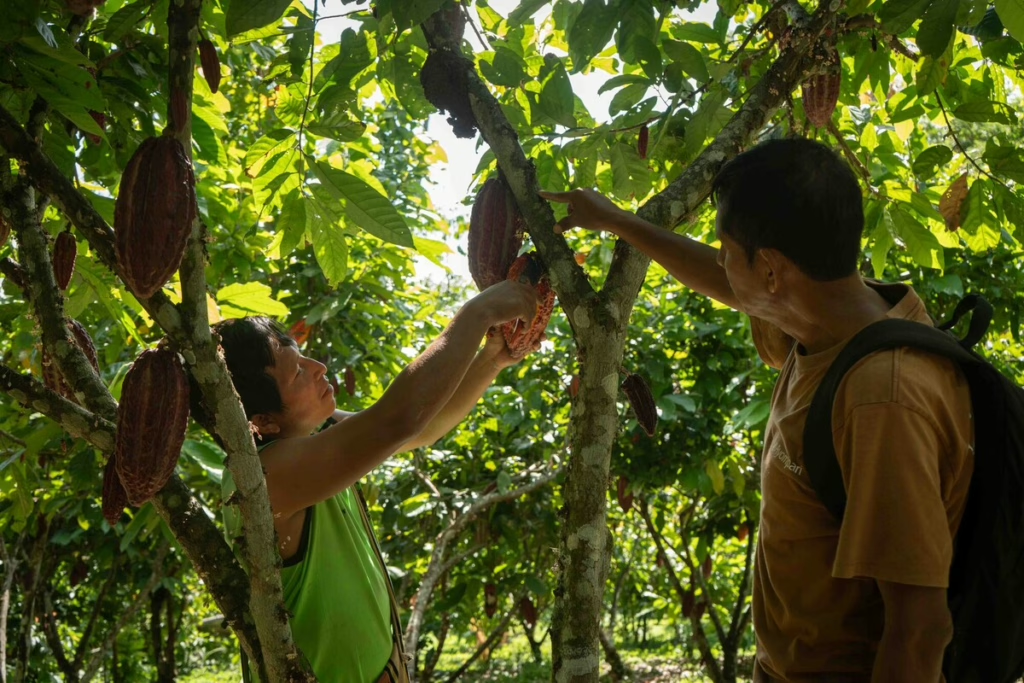
“Cool Earth took a different approach. It embraced direct funding, community-led action, trust and risks.
Because the climate crisis is not waiting for perfect governance structures or endless consultation processes.
When communities have financial security, they are better able to protect forests. It really is that straightforward.
Cash payments allow families to:
- Adapt to climate shocks
- Invest in sustainable livelihoods
- Keep children in school
- Access healthcare
- Protect their land
- Preserve traditional knowledge systems that have preserved the rainforest for centuries.
And the evidence is increasingly clear: it works. It is fast, it is cost-effective, and it delivers benefits immediately.
I am Cool Earth’s greatest fan but even I was surprised to see third party evaluations show that after 18 years, its partnerships have kept 99% of forest intact in the areas where they work.”
Lessons learned from the Amazon.
“I have seen this firsthand.
Years ago, I bought large areas of rainforest in Brazil, not because I believed forests should belong to outsiders, but because I wanted to stop them being destroyed.
But what became obvious very quickly was that conservation imposed from outside always failed unless local people were empowered to lead it.
Under their leadership, the future of the rainforest can be shaped in many places. By boardrooms in London, Brussels or New York, where investment decisions determine how capital flows around the world. By governments, regulators and international institutions. Success depends on bringing these worlds together at the speed and scale the crisis demands.
This is where I believe the business community must now step up.”
Why businesses must act.
“Because at precisely the moment when we need greater ambition, we are seeing many companies retreat.
Across industries, we are seeing:
- Sustainability teams being reduced
- Climate commitments being watered down
- Environmental investment slowing
Some businesses have decided that because politics have become more difficult, the safest option is to say less and do less.
That is a profound mistake because there is nothing “anti-business” about protecting nature. Quite the opposite, in fact.
This is not about ideology. It is about reality.
And reality is changing faster than our institutions are prepared to accept. The pace of environmental breakdown is accelerating which means our response must accelerate too. We do not have time for performative action. We do not have time for endless bureaucracy. And we certainly do not have time to abandon hope.”
Reasons to stay optimistic.
“Because despite everything, I remain optimistic.
As a fellow Swede, renowned climate scientist and Cool Earth ambassador Johan Rockström has said many times: “It is never worth giving up. Solutions are no longer seen as utopian fantasies but as scalable, replicable and achievable in one generation.”
I have seen what human beings are capable of when trust, courage and action come together. I have seen communities restore degraded land. I have seen forests recover. I have seen people protect extraordinary ecosystems against enormous odds.
And I have seen how quickly change can happen when resources finally reach the people who need them most.”
Nature is the foundation for progress.
“My message today is simple.
If we want a stable future, we must protect the natural systems that protect us. If we want resilient economies, we must invest in resilient ecosystems. If we want security, prosperity and growth, we must recognise that nature is not a barrier to progress but the foundation of it all.
The forests standing today are not there by accident. They are standing because people have defended them, often at great personal risk, with very little support.
The least we can do is stand with them. This fight is not about saving trees, it is about safeguarding the conditions that allow humanity to flourish.
The snow I skied through as a child in Sweden taught me something important. Nature can feel permanent, but it is not.
The stability we inherited is not guaranteed for future generations. Whether our children inherit a liveable world now depends on the choices we make in this decade.
History will not judge us by the promises we made, it will judge us by whether we acted while there was still time.”
How you can action Johan Eliasch’s message today.
The climate and nature crises can feel overwhelming, but Johan Eliasch’s message is ultimately one of empowerment. Real change happens when people, businesses and communities take practical action and support those already making a difference.
Here are a few ways to turn these ideas into action:
- Support or donate to organisations like Cool Earth that work directly with Indigenous peoples and local communities protecting rainforests.
-
Advocate for policies and business practices that don’t cause harm to important ecosystems like rainforests, or cause human rights abuses to rainforest communities.
- Encourage your workplace to strengthen — not weaken — its sustainability commitments.
- Use your voice, your vote and your purchasing power to support solutions that protect ecosystems.
Protecting nature is not a niche environmental issue. It is one of the most important investments we can make in our collective future.
The question is no longer whether we can afford to act. It is whether we can afford not to.